
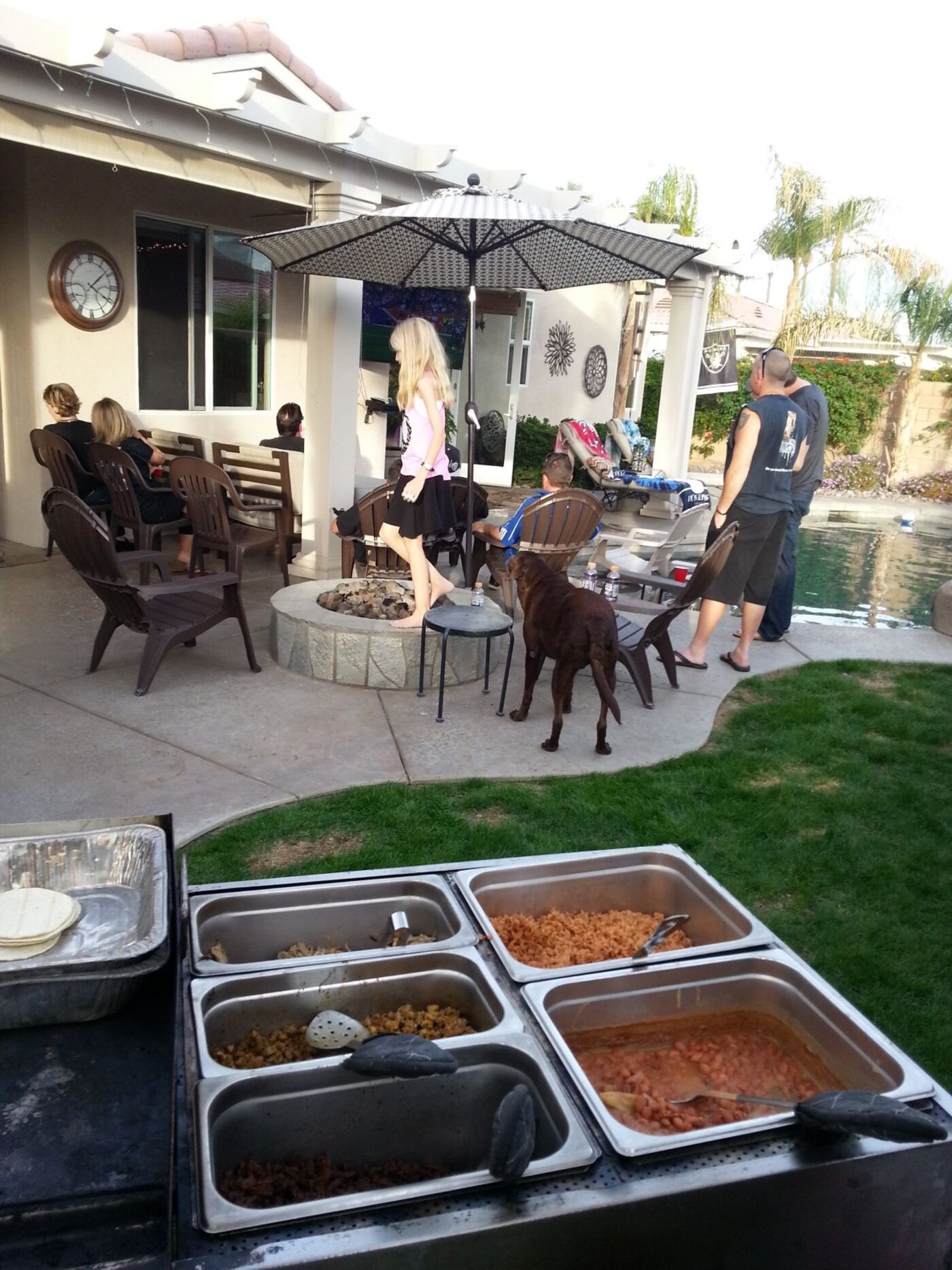
How do you price taco catering so you make money on the party?
You worked a full season of parties. Every one of them went well, people loved the food, and your account looks about the way it did before the season started. Nobody can tell you where the money went, because it never showed up in the first place.
The parties were real and the customers were happy. You just never got paid.
The reason is not that you need more parties. It is a price that was never built to carry you, and you can fix it at your kitchen table in one sitting.
Here is the fix. Work out what one party size actually costs you to put on, then build your price on that number. The cost is everything the party takes out of you: the food, your crew’s hours, the fuel, the supplies, the drive, and the wear on your gear. Then add the three lines nobody bills you for: your personal pay for the work you did on the party, the money that stays in the business to run it, and the profit the business earns on top. Do that for every size you run, and publish a price for each one. If you put a price on a party without knowing what it costs you, you can book it, work it, and finish the day behind without ever finding out.
Show your prices however you want, by the way. Some caterers publish a per person figure because it reads well to a customer, and there is nothing wrong with that. What matters is where the number came from. It has to come out of a costed package, because a party that lands a few guests over one of your sizes gets that package price, not the package with extra heads multiplied on top.
Start with the napkin
You do not need a spreadsheet to price a party. Take one party size and write down two groups of numbers.
What the party costs you. Everything the party takes out of you that has a receipt behind it. The food, the service ware and disposables, your crew, the fuel you cook on, the drive, a party’s worth of wear on your gear, and whatever else your own setup costs you to put that party on. Your offer decides that list, not mine.
The three nobody bills you for. Nothing reminds you about these, so they only exist if you write them down:
- Your pay. Your personal pay for the work you did on that party.
- Operating cash. What stays in the business so the business can pay for itself, whatever comes up. A repair, a replacement, something you need to buy, a slow stretch, the food for the parties already booked if you have not taken a deposit on them. You will not predict the list, which is the reason the money has to be there.
- Profit. What the business earns on top of all of it. That is yours, and it is what is still there at the end of the quarter.
Add both groups together. That total is your price for that size. Nothing goes on top of it, because the three lines most guys staple on the end as an afterthought are already inside it.
Then do the next size. One sitting at the kitchen table and you have a price you can say out loud when the phone rings instead of doing math at a red light.
That is the whole method, and the rest of this page is the same two groups with more room to work: where each cost hides, which lines move with the party and which ones you decide, and a sheet you can fill in when you want one.
The party that pays you nothing
Think about a party you ran this year. Somebody messaged you on a Tuesday, asked what you charge, and you gave him the number you always give. He said yes. You shopped, you prepped, you loaded up, and you drove out. You set up, you cooked, you served, you broke down, you drove home, and you cleaned up that night. Everybody ate well. He paid you exactly what you agreed. Nothing about that day told you it lost money.
That is the thing about a party priced below what it costs. It never feels like a loss. What it feels like is work.
Nobody hands you a bill for the difference. You bought the food, paid the crew, filled the tank, and drove home tired with a check in your pocket. What went missing was your money, and it went missing quietly, one party at a time, all season. By the time you sit down months later and go looking for it, it has been gone a long while.
You should know who is telling you this. I built and ran an on-site taco catering business for about ten years, more than two thousand parties, and I started the marketing work I do now while that business was still running. The catering years are behind me and marketing is the job today, so nobody on this page is going to tell you what to charge, because nobody can. What this page does is make sure the number you charge was built on what your party costs you, so you know which parties are worth taking before you take them.
Three lines nobody bills you for
Here is how it usually happens, and it is an honest mistake, not a math problem. You add up the food. You add up what you pay your crew. You throw in the fuel, the supplies, and the drive. A price goes on top of all that, and it looks like there is money in it. Everything you could see was in the price, so the price cleared.
Three things were not on that sheet. None of them is a cost, so none of them shows up on a receipt, and a price that covers everything you can see will clear without them.
Your own pay
What was not on the sheet was your day. The shopping, the prep, the loading, the driving, the cooking, standing there for the whole service, the breakdown, the cleanup at home afterward. None of that was in the number, so the price never had to cover it. You worked for free without ever deciding to.
“I don’t count my own hours, that’s just the job.” That is the sentence that empties the account. Your pay is a line like any other line. You decide what your day is worth, you write it down before you set the price, and the price gets built on top of it. If a size cannot carry that number, you have learned something real about that size, and you learned it at your kitchen table instead of at the end of a Saturday that ran fourteen hours. If you would pay somebody else for those hours, pay yourself for them.
Profit the business keeps
Profit is not your pay. Your pay is your personal pay for the work you did on the party, and you take it. Profit is what the business earns on top of everything, once every cost is covered, you are paid, and the money the business runs on is still sitting there. That is what is left at the end of the quarter, and it is yours. They are two different things out of the same price, so if you only put one of them on the sheet, the other one is not happening.
A guy who covers his costs, pays himself for the day, and stops there does not have a business. He has a job that owns a cart. Nothing accumulates, and nothing is there when the cart needs work or a slow stretch runs longer than it should. He can be busy every weekend of the year and still have nothing to show for the year, and he will not be able to point at the party where it went wrong, because it did not go wrong at any one party. It was never in the price.
So profit is a line, and you decide it before you set the price, exactly the way you decide your own pay. It is not whatever happens to be sitting in the account at the end of the season.
If you want to read further on that idea, there is a whole method built on it, and a book: Profit First, by Mike Michalowicz. It is not written for caterers and it is not what this page is teaching, but it is where the thinking comes from, and it is worth your time if the money side of the business is what keeps you up at night. The part you need for pricing a party is the part in the paragraph above.
Operating cash for the next parties
“My deposit money is already gone before the party happens.” If that is you, this is the line you are missing. The price you charge for this party has to leave money in the business, and the clearest case is the food and supplies for the parties already on the calendar behind this one.
If you take a deposit, that particular problem is handled: the food for the next party is paid for before you shop for it. The line does not go away, because the business needs money for more than groceries. A grill quits in July. The canopy tears. A tire, an insurance renewal, another cart when you outgrow the one you have, a vehicle eventually. Your cost stack already charges every party for a party’s worth of wear on your gear, and that money has to be sitting somewhere when the gear finally needs replacing, or the wear line was just a number on a sheet.
So this is the money the business runs on, and it stays in the business. It is not your profit and it is not your pay. Spend it on either and the next party, or the next grill, comes out of your pocket.
When it does not, every party you book is funded out of whatever was left over from the last one. That works right up until it does not, and it usually stops working in the middle of a good run. The deposits have not landed yet, there are parties stacked on the calendar, and you are standing in the store deciding what to put back. Being short at the store in a busy stretch is not bad luck and it is not a math error. It is a price that never carried the next party.
So it goes on the sheet too, before you price, same as the other two. Keep these three in front of you through everything below, because they are the lines the party will never remind you about.
Building the sheet for one party size
You are going to take one party size, name every cost that goes into it, and put a price on that size. Then you do the next size. It is a sitting, not a weekend, and the heavy part only happens once.
The reason you have never done it is not that it takes long. Every free hour you have goes to shopping, prep, or recovering from the last party. A blank sheet is the one thing that can wait until next week, and it has been waiting a lot longer than that.
Why you will not find a single number on this page
“The other guys charge about this, so I’ll come in a little under.” That is how most guys set a price, and it is why the price does not work. Somebody else’s number teaches you his parties, in his town, with his food, in the years he ran them. It tells you nothing about what your Saturday costs you.
Every caterer’s package is different. What you include, what you charge extra for, how much of it you put out, what quality you buy. Some guys offer more than the next guy does, and that guy’s cost is higher, and he needs to know it. Nobody can copy anybody else’s price, because nobody else’s package is your package. So there are no sample numbers and no averages here. A sheet full of somebody else’s figures is exactly the thing that cannot help you.
Go look at ten taco catering sites. You will find prices on most of them and almost never a word about how anybody arrived at them. Almost nobody in this business shares real costs or quantities, which is why you have had nothing to compare against except other guys’ prices. What this page teaches is what drives each cost, and that holds for your parties, in your town, this year.
Start with the sizes you actually run
I am not picking your sizes for you. You already know them, because they are the parties that keep landing in your phone. Write them down. Those are the columns on your sheet, and nothing else on this page decides them.
Then get this straight, because it is where pricing goes sideways. Head count picks the package. It is not something you multiply by. The reason is practical, not theoretical. Nobody knows how many people are actually at a party. You are not standing at the door counting them, and neither is the host. What the customer tells you is how the two of you choose which package he books.
“They told me one number and a lot more people showed up.” Every caterer has that story, and it feels like the customer got one over on you. Under a package it does not work that way. Once the party is booked, that size is a label on a package, not a measurement anybody takes on the day. You serve the food you prepared for that size, and when it is gone, it is gone. A number nobody can check is not a number you can multiply by. Build the package so it carries you at that size, and stop trying to collect for extra heads after the fact.
Decide the food for a size, then cost it once
Whatever you serve for a size, that decision is yours and it does not move party to party. Same size, same food, same amount of it. That is what makes a size costable before you have ever met the customer.
You cost it once. You go to the store you actually buy from, you price what goes into one size, and you write it on the sheet. That line is good until your suppliers move on you.
If you serve all you can eat, this still holds, and it is worth saying why, because it looks like it should not. All you can eat runs until the food you prepared for that size runs out, and you decided how much that was before you left the house. Across a party of that size, appetite averages out. One guest eats more than you would believe and the next one barely touches it. That averaging is what lets a quantity settle at all, and it works the same way whether you serve all you can eat, a set number per guest, or something else. All you can eat is one way some caterers run it. It is not the model. The model is that the food for a size is a decision you already made.
Price the exact thing you buy, not the category
If you price a category, you have priced nothing. Categories do not have prices. The exact item you actually buy does.
Two things can sit in the same category, feed the same party, and land in completely different places on your sheet. One might cost you a multiple of the other, every single party, forever. One might be quick and easy while the other ties up a burner or a person for hours. Averaged together in your head, they are a guess. Priced separately on paper, they are a fact.
So when you cost the food line, price the exact item, at the size you buy it in, from the place you actually buy it. And when you are thinking about changing something on your menu, cost both options into the same party size and put them side by side. That comparison shows you what a menu choice is really charging you per party. Some choices cost less than you feared. Some cost more than you would ever have agreed to if somebody had shown you the number first.
What is in the stack, and what each line moves with
Food is the line everybody thinks of, and it is nowhere near the whole cost. The rest of it is where the money quietly goes.
What follows is not your list. It is the kinds of lines a cost stack has. Your offer decides your list, and if you do more than what is named here, your stack is longer, and those extra lines are yours to add.
- Your own pay. It goes on the sheet first, not last.
- Profit for the business. What the business keeps on top of what you pay yourself. You set it before you price, and it stays on the sheet whether or not the party leaves anything behind.
- Operating cash the business runs on. What stays in the business to shop for the parties already on the calendar, and to replace the gear when it is time.
- The food for that size. Costed once, as above.
- Serving supplies. Whatever a guest eats off, eats with, and wipes his hands on, if you are the one providing it.
- Working supplies. Foil, gloves, towels, containers, cleaning, all the stuff that gets used up and never gets noticed.
- Your crew’s hours. Everybody on the job, for the whole time they are on it: the load in, the setup, the service, the breakdown. However you pay them, it lands on the sheet as one cost for the party. If you do not already know that number, hours on site times crew on the party times what you pay them gets you there.
- The fuel you cook on. It burns for the whole cook, not just while guests are in line.
- Travel. The drive out and back, and what it costs you to get your cart and your gear there and home again. If you charge a travel fee now, this is the line it was trying to cover.
- Setup and breakdown. The time before anybody eats and the time after everybody leaves.
- Equipment. Whatever you cook on, haul, and serve from. It wears out and it gets replaced, and the parties you ran are what wore it out.
- Anything else this size costs you. Yours to name. If you offer something the list above does not cover, it belongs here, and leaving it off does not make it free.
The first three are not costs. Nobody invoices you for them, which is exactly why you have to write them down like the ones somebody does invoice you for.
Now the part that is worth more than the list itself. Most of those lines move with something, and the ones that do not move at all are the ones you have to decide. Knowing which is which is what lets you price a size you have never run before.
| What it moves with | The kinds of lines | What that means for you |
|---|---|---|
| Nothing. You decide them | Your own pay, profit for the business, operating cash for the next parties | These do not move with the party at all. No supplier sets them and no receipt reminds you of them, so they only exist if you put them on the sheet before you price. |
| Party size | Food, serving supplies, working supplies | Fixed once you have decided what a size gets. This is what makes a package possible at all. |
| Hours on site | Crew hours, the fuel you cook on | These are the lines that grow when a party runs long. Work out what an extra hour costs you on your own setup, and you will never have to guess at that question again. |
| The gig, flat | Travel, setup and breakdown, equipment | Does not shrink when the guest list does, which is why a small party has to be costed on its own lines instead of scaled down from a bigger one. |
Once you can look at any line and say which of those four rows it belongs to, you can price anything. That is the part that survives every price increase, every new menu, and every year.
Where an item costs you money and where it costs you time
Every item on your menu costs you in one of two places, and telling them apart is how you decide what belongs inside the package.
Some things are cheap to buy and expensive in labor. The ingredients are almost nothing. The work is real: hours of cooking, attention, a burner or a person tied up while it happens. It looks free on the receipt and it is not.
Other things are easy to cook and expensive to buy. They go on and they are done, no trouble at all, and then the invoice arrives. No labor problem, a real hit to the food line.
That is the decision. An item that costs you time can live inside the package when your crew has the hours to give it. An item that costs you money usually has to carry its own price, because including it quietly eats the margin on every party you run.
Two checks on your own list. An add on that nearly every customer buys is not really an add on, it is part of your package, and it should be costed inside it. An included item that almost nobody touches is a cost you are eating for nothing.
And the bigger point underneath both: the more you offer, the more your parties cost you. That is not a problem, and offering more may be exactly why customers pick you. It only becomes a problem when the extra is on the cart and not on the sheet.
The price you put on your site
You have a size, and you have every line for that size: the costs, your own pay, the profit, and the operating cash for the next parties. Total them. That total is your price for that size, and you add nothing on top, because the three lines most guys stack on the end as an afterthought are already in it.
That is the difference this sheet makes. A price built the other way is a pile of costs with a guess stacked on the end, and the guess is the first thing you shave when a customer pushes back. “I always end up giving them a deal” is what a guessed price sounds like from the inside. When the number is a total of lines you wrote down yourself, a discount has a name. It is your pay, or it is the profit, or it is the food for the next party. You can still say yes if you want to, but you will know exactly what you handed over. Most guys stop handing it over once they can see it.
When the number comes out higher than the other guys
This is the fear that has kept the sheet blank, so let us say it out loud. If you price it right, the number might come out higher than everybody else’s, and the phone might stop ringing.
Here is what the sheet actually tells you when that happens. The other guy’s price is not right because it is lower. It is wrong for you, because it did not come from your costs, and for all you know it did not come from his either. He may be working for free the same way you have been. The fact that a busy guy charges less than you does not mean his price pays anybody.
Your identity in town might be the guy who is a good deal. “Everybody says I’m the best deal in town and that’s the problem.” A real price might mean a few customers go somewhere else, and it might mean some of them were never worth having. That is what knowing which parties to say no to looks like in practice. The party that only books you because you are cheapest was the party that paid you nothing. Losing it costs you a Saturday you get to keep.
Publish it and stop doing math at a red light
Publish the price. That is the point of doing the work in advance. The cost work happens once, at your table, and the price goes on your site. When a request lands, you are not calculating anything in your head at a stop light. You are helping somebody pick the package that fits his party.
How you display that price is your business. Show it per person if that reads better to your customers, because plenty of caterers do and there is nothing wrong with it. Just remember what is underneath it: a costed package for a size, not a rate you multiply by heads. When a party lands a little over one of your sizes, it gets that package. If the party runs an extra hour, you already know what that hour costs you from the table above, so you can quote it without your stomach dropping.
Redo the sheet when your costs move
Redo the work when your costs actually move, not on a calendar and not when the competition moves. Your food goes up, you give somebody on your crew a raise, you replace the cart, you start driving farther. Those are the triggers. A price you have not looked at since your costs changed has quietly stopped working. The other guys’ number has nothing to do with any of it.
Keep the sheet, because the first numbers are estimates
The first time you fill this sheet in, some of the lines are estimates. That is fine, and it is not a reason to put it off. It is a reason to keep the sheet.
Nobody gets the quantities right at the start, and there is no formula for it, because it depends on your menu, your portions, how you serve, and who shows up to parties in your town. “I ran out of food and had to send somebody to the store” is not a character flaw. It is a quantity that has not settled yet. So write down what you bought for a party of that size and what happened. Did you run short? Did you drive home with food? Adjust it next time and write that down too. Do the same with the hours: what you thought the day would take and what it actually took.
After a few parties at a size, the numbers stop moving. That is when it is dialed in, and it is dialed in for you. You are not slowly guessing better. You are measuring something genuinely stable, because appetite averages out across a party even though no two guests are alike.
Close the loop on a party you already ran
This is where the whole page pays off.
- Take a party you already ran and put its real costs into the sheet against the price you actually charged. Your own pay included, and the profit and the operating cash with it.
- Look at what is left at the bottom. That is what the party really did for you.
- If it comes out lower than you assumed, you have found the thing this page was written about. Same goes if it only clears once you quietly drop one of those three lines.
- Fix it on the next party of that size instead of running it again next season.
The worksheet
This is the long version, and you do not need it today. If you worked the four steps at the top of this page on a napkin, you already have a price you can quote. The sheet below is for later: when you want to see exactly where the money goes, or when you have run a few parties at one size and you want that size settled for good. Starting here first is how this gets frustrating, so do not. Come back to it when the napkin has you asking a harder question.
Here it is, free, nothing to sign up for. Same lines you just read about, grouped by what drives them, with the three you decide yourself sitting at the top of the sheet where you cannot skip past them. One column for each party size you run, and you name the sizes yourself.
It is blank on purpose. No sample column, no example figures, nothing filled in, because a sheet full of somebody else’s numbers is exactly the thing that cannot help you. Every group has an empty row for a line I did not name, because your offer is not my list.
Work down it in order, one size at a time, starting with the size you run most. The second size goes faster than the first, and the one after that is nearly quick. Fill it in here, print it, or download it and keep it with your files. What you type stays on your machine.
More Taco Gigs · what one party size costs you |
|---|
moretacogigs.com/guides/price-taco-catering-packages/ · taco catering leads, websites, Google Business Profile management |
|
More Taco Gigs What one party size costs youmoretacogigs.com/guides/price-taco-catering-packages/ A blank sheet for working out your own cost on one party size, so you can set a package price for that size and publish it. Every box on this sheet is empty on purpose. There are no example figures on it, and there never will be. Nobody else’s prices are any use to you: your menu, your crew, your drive and your market are not theirs. These are the kinds of lines a cost has, not the whole list. Every taco guy offers something different. If you include something the next guy charges extra for, your cost is higher and you need to know it, so every group has a blank line for whatever is yours.
Both downloads are built right here in your browser and saved straight to your device. Nothing you type is sent anywhere, and nothing is asked of you for it. The filled download is the same sheet you see here, with your own entries in it, ready to open in a spreadsheet. Your cost by sizeFilled from the sheets above. Every size you cost out lands here, so you can see the whole ladder at once before you set your package prices.
NotesYour own pay is the first line on this sheet on purpose. Leave it out and a price that loses you money still looks fine. Your pay and your profit are two different lines. Your pay is your personal pay for the work you did on the party, and you take it. Profit is what the business earns on top of everything once the costs are covered, you are paid, and the money the business runs on is still there; that is what is left at the end of the quarter. Cover your costs, pay yourself and stop there and you have a job, not a business. Both are decided up front and built into the price, and so is the third line: the money this party leaves in the business, for the parties already booked and for the gear when it needs replacing. If you want to read further on running a business that way, the method is called Profit First, by Mike Michalowicz: mikemichalowicz.com/profit-first/ The leftover line is the reason the sheet exists. Put in the price you were thinking of charging and see what the party actually leaves you once your own pay, your profit and the money for the next parties are already counted. Your first quantities for a size will be wrong. Write down what you bought and what happened, change it next time, and after enough parties at this size the number stops moving. That is when the size is dialed in. The per person row is the total divided by the size. It is not a rate you set, and it is not a rate you multiply by a head count. Nobody counts the guests at a party, so a party that lands a little over a size gets quoted that package. This is a private working sheet. Nobody in this trade publishes his costs or his food quantities, and there is no reason for you to be the first. This sheet came from More Taco Gigs. I sell taco catering leads, I
build sites for taco caterers, and I run their Google Business Profile. |
Sheet
Your cost for this size
This is the number you price a package against. Your own pay, your profit and the money for the next parties are all already inside it. What you charge for this size is your call, and it has to sit above this line.
If you want the per person figure
Your cost per person
That is a breakdown of the package, nothing more. It is the total divided by the size, not a rate you set and not a rate you multiply by. Nobody counts the guests at a party, so a party that lands a little over this size gets quoted this package, not this figure times a head count. Show your prices however you like. Work them out here.
What this party actually leaves you
Put in the price you were thinking of charging for this size. Your own pay, your profit and the money for the next parties are already in the cost above, so this is what the party leaves you on top of all three.
Left over, after everything
After the party: what actually happened
Your first quantities for this size will be wrong. You will run short, or you will drive home with food. Write down what you bought and what happened, change it next time, and after enough parties at this size the number stops moving. That is when the size is dialed in, for your menu and your crowd.
| Date | What you bought | Short, right, or food left over | Change for next time |
|---|
Once you have a price you trust
Knowing what a party costs you fixes the half of this business that happens at your table. The other half is people asking about parties in the first place. That is what I do now: I generate real taco catering opportunities and sell them to caterers who are ready to answer the phone. When you have a price you can say out loud without your stomach dropping, you are going to want more people to say it to.
Keep Going
For the bigger picture of getting more taco catering bookings, read Why the Best Taco Caterer in Town Still Stares at an Empty January.